Design Meets No-Code: Building Seamless Websites Faster

Once upon a time, design and development lived in separate worlds.
Designers sketched.
Developers coded.
Collaboration meant handoffs, translation errors, and long waits.
But something has changed: no-code is now the creative bridge.
It’s not a replacement for engineers.
It’s a creative accelerant — a place where design logic flows directly into execution.
And when design and no-code work together, something powerful happens: websites get built faster, with more fidelity, and with fewer compromises.
What Designers
Really
Want
Not dashboards full of tasks.
Not endless review cycles.
Not another tool that “sort of works.”
Designers want clarity, flow, and control:
- The ability to see every interaction
- Freedom to test and iterate
- Confidence that visuals become real interfaces
- Fewer translation losses between idea and outcome
No-code delivers all of that — not by replacing code, but by making design actionable.
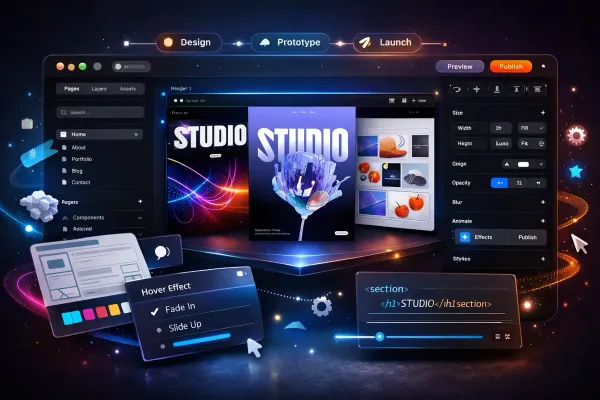
No-Code Turns Concepts Into Reality
Traditional workflow:
Idea → Sketch → Mockup → Handoff → Interpretation → Build
No-code workflow:
Idea → Canvas → Interaction → Live Website
The second feels cleaner because it is cleaner. The designer is empowered to prototype with real structure, real behavior, and real outputs — not placeholders.
No-code lets designers:
- Build components that behave like real UI
- Link up navigation without dev tickets
- Add interactions that feel like finished products
- Publish live without complex deployment
Design stops being a plan. It becomes a functioning system.
Design Thinking Becomes Build Thinking
Great design isn’t just visual — it’s structural.
When designers work in no-code environments:
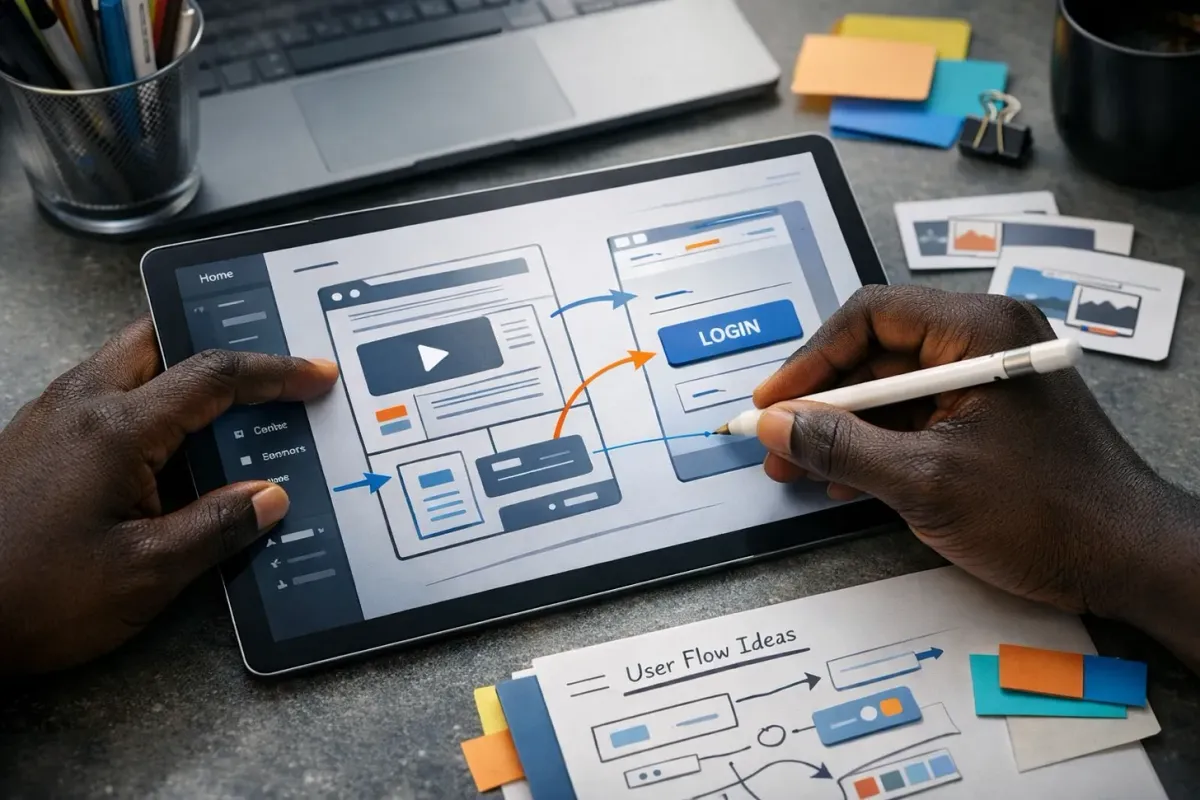
- User flows are tested, not theorized
- Interactions become real experiences
- Layouts adapt to content instead of guessing at it
- Feedback is immediate and actionable
Design becomes less about pictures and more about behavior.
Instead of designing for interpretation, designers design for execution.
Speed Without Sacrificing Quality
No-code doesn’t just speed things up.
It stops a lot of rework before it starts.
Designers can:
- Validate ideas quickly
- Iterate without developer backlog
- Test functional prototypes with real users
- Deploy live without translation errors
The result? You build products that feel both thoughtful and purposeful.
Fewer rounds of fixes. More rounds of progress.
Collaboration Gets a Shared Language
One of the biggest gains isn’t technical — it’s communicative.
When design lives on a canvas that behaves like a real site:
- Developers see intent immediately
- Designers speak implementation language
- Teams iterate with one shared truth
No-code becomes the common ground where design and development stop guessing and start building.
Why This Matters
We live in a world where:
- Attention is short
- Competition is fast
- Experience is everything
- Expectations are high
In that world, the tools that remove friction win.
Design and no-code shared space is not about simplifying complexity — it’s about enabling creative fluency.
Designers can stop asking for code.
They can start thinking like builders.
And that changes everything.