My A+ Blueprint: Building the Foundation for a Career in IT


When I decided to take my transition into tech seriously, I wanted a starting point that wasn’t just about passing a test, I wanted a foundation. Something that made me understand technology, not just memorize it.
That’s when I committed to earning my CompTIA A+ certification, using Professor Messer as my main resource.
This post isn’t a tutorial or a study dump. It’s my blueprint, how I’m approaching the A+ exam from the ground up, what tools I’m using, and the mindset I’m bringing into it. If you’re on a similar path, maybe this helps you see how to build your own structure without losing yourself in the noise.
Why I Chose the CompTIA A+
I didn’t want to skip steps. A lot of people try to jump straight into cybersecurity or networking because those sound more exciting, but the A+ certification is where you learn the language of IT.
It teaches you how computers think, break, and communicate, and how people use them in the real world.
For me, that matters. Coming from the Marine Corps and running my own business, I’ve learned that structure matters more than speed. You can’t protect what you don’t understand, and you can’t fix what you’ve never built. The A+ exam is the foundation I’m laying before moving into deeper waters.
“Structure matters more than speed. You can’t protect what you don’t understand.”
My Main Resource: Professor Messer
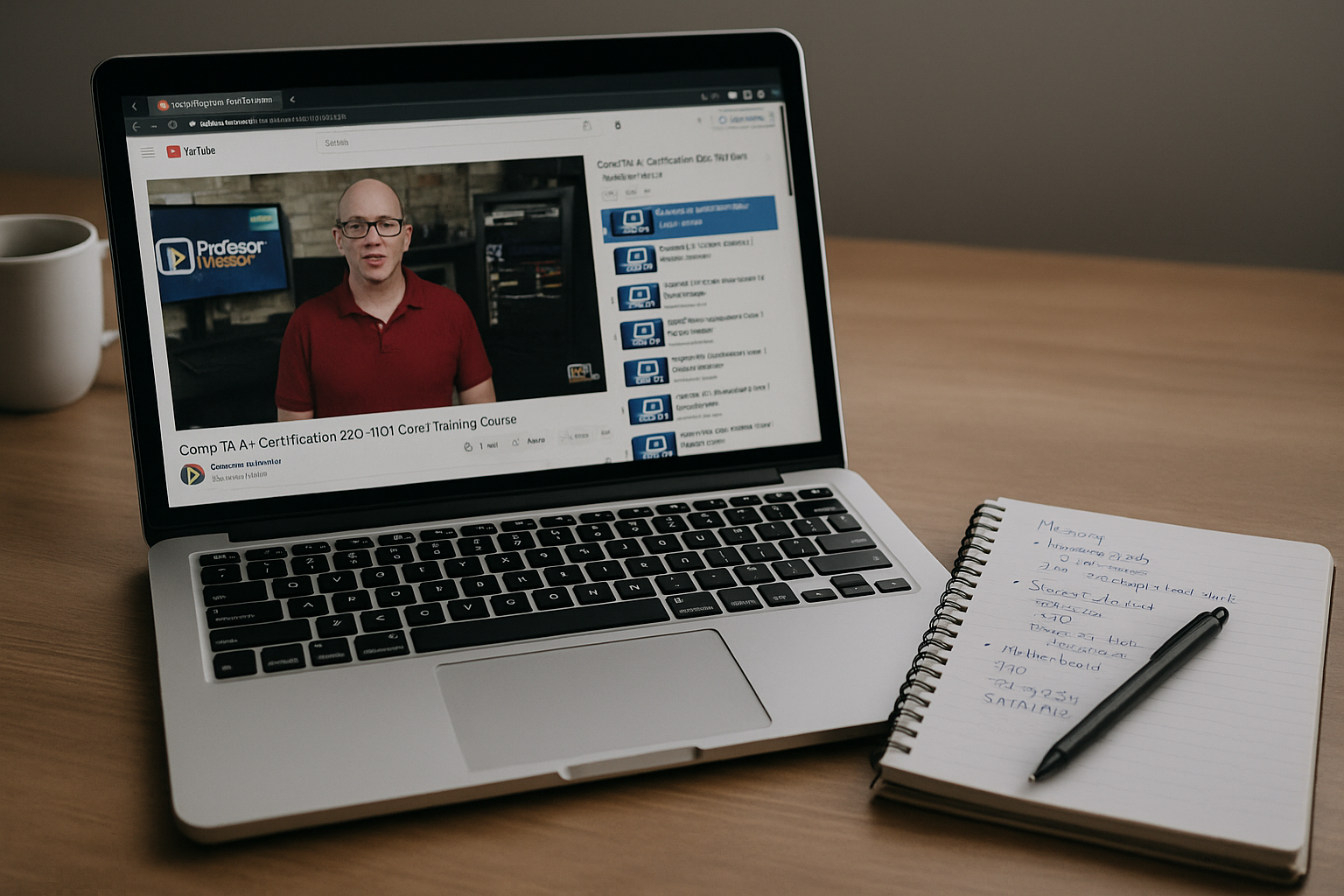
There’s a lot of A+ material out there, bootcamps, paid courses, study apps, but Professor Messer stands out for one reason: he teaches, he doesn’t just lecture.
His free YouTube course covers every single A+ objective with clarity, and his Course Notes and Practice Exams are simple but effective. There’s no filler, no wasted time, just the information you actually need, presented in a way that sticks.
How I Use His Material:
1. Daily Videos — I treat each one like a mini-class. No multitasking, no background noise.
2. Written Notes — I summarize key points in my own words. Writing helps me retain them.
3. Weekly Reviews — I revisit older topics to keep them fresh.
4. Practice Questions — I test myself after every major section, not just at the end.
Sometimes I’ll pause a video and explain the concept out loud, almost like teaching it back to myself. It sounds weird, but it works.
My Study System (Consistency Over Intensity)
I don’t study for eight hours straight. I study smart and consistently. My schedule looks something like this:
• Monday–Friday: One to two videos per day (roughly 45–60 minutes total).
• Saturday: One-hour recap and self-quiz session.
• Sunday: Rest or light review — usually just revisiting weak areas.
The goal isn’t to rush through all the content , it’s to actually absorb it.
If I don’t understand something like BIOS settings or subnet masks, I pause there. I’ll look up diagrams, or rewatch a section until it feels natural.
“Consistency builds confidence. Every small session compounds over time.”
Breaking It Down by Objectives
The A+ exam is split into two parts — Core 1 (220-1101) and Core 2 (220-1102). Each one focuses on different areas:
• Core 1: Hardware, networking, mobile devices, and troubleshooting.
• Core 2: Operating systems, security, and operational procedures.
I’m tackling Core 1 first, because it’s the physical side of tech, understanding how the pieces fit together. Once that’s solid, Core 2’s software and security topics make a lot more sense.
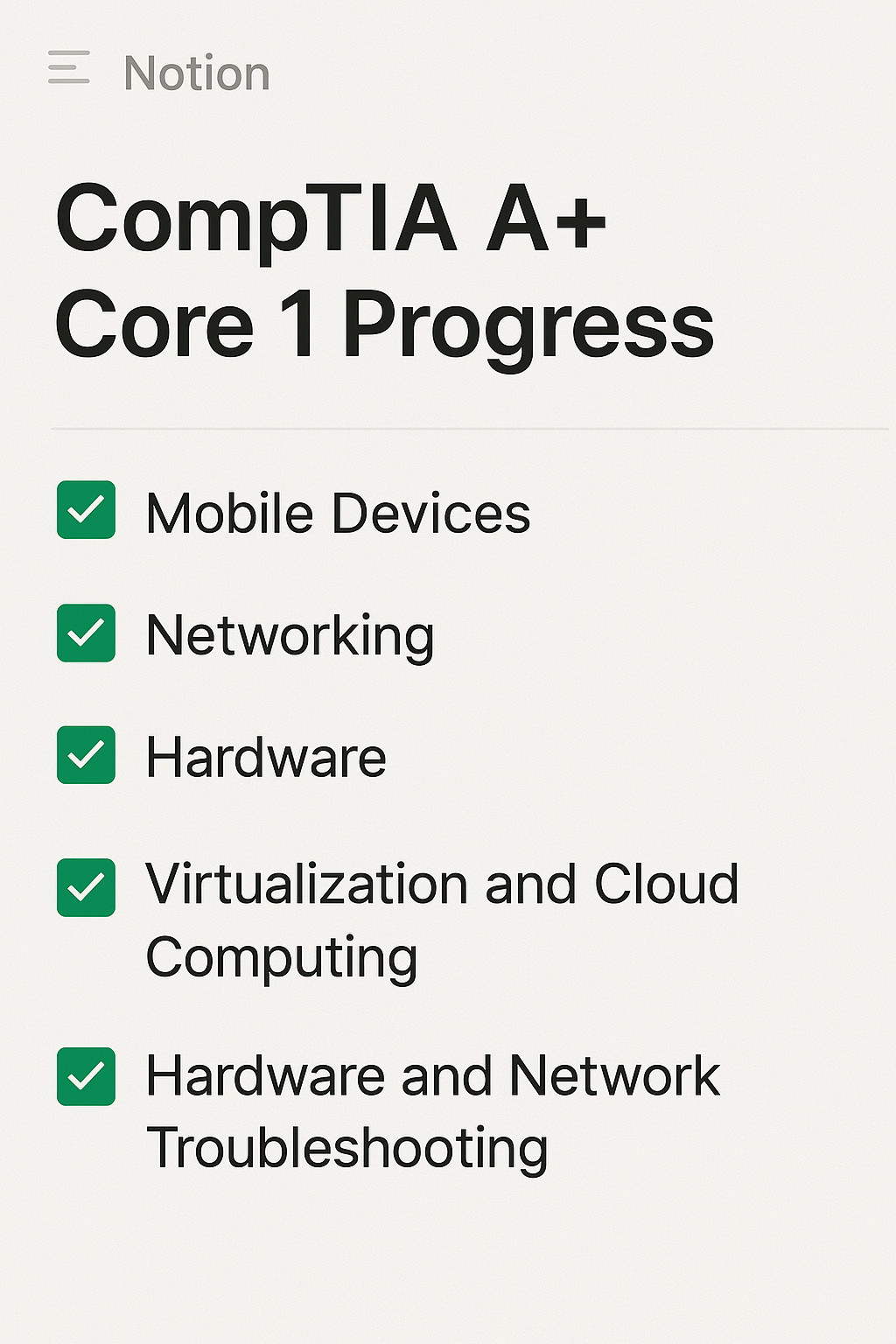
I created a simple Notion checklist of all the CompTIA objectives. Every time I finish a topic (like “1.3 Install and configure PC components”), I mark it green.
It’s not about making the page look pretty, it’s about visual proof that I’m building something piece by piece.
Tools That Keep Me Grounded
Besides Professor Messer, here’s what keeps my study process tight:
• 🧾 Professor Messer Course Notes (PDF) – Perfect for quick refreshers.
• 💻 ExamCompass – Free practice quizzes that test you by topic.
• 📱 Brainscape Flashcards – I use these to turn Messer’s concepts into bite-sized memory drills.
• 🧠 Notion + iPad Notes – To keep everything structured and synced.
• 🕓 Timer Method (Pomodoro) – 25 minutes on, 5 minutes off. Keeps me focused.
I don’t rely on fancy apps. Most of this can be done with a simple notebook and determination. The tools just make it easier to stay accountable.
How I Measure My Progress
I measure progress in understanding, not hours.
Every Sunday, I test myself on 20 random questions. If I miss one, I don’t just mark it wrong, I write out why I missed it. Sometimes it’s a knowledge gap, other times it’s test wording.
When I can consistently explain the why behind each correct answer, I know I’m leveling up.
My goal is to hit 85–90% on practice exams before scheduling the real test. That way, even if exam-day nerves hit, I’m still on solid ground.
“If I can explain the why, not just pick the right letter, I’m ready.”
Balancing Study with Real Life
Balancing study time with running a business isn’t easy. Between clients, creative work, and regular life, I have to protect my energy.
So I built my system around discipline, not motivation. Motivation fades; structure doesn’t.
Sometimes that means studying at 10 p.m. after a long day. Sometimes it means skipping a day and catching up later. What matters is not losing the rhythm entirely.
The Marine Corps taught me how to stay structured. Entrepreneurship taught me how to stay flexible. This mix is what makes studying sustainable, and that’s what most people overlook.

Mindset Over Memorization
You can memorize definitions all day, but IT is about problem-solving.
If a printer doesn’t connect, or a PC won’t boot, nobody cares if you remember a term, they care if you can fix it.
That’s how I approach my studies: with curiosity. I don’t just want to know how to do something; I want to understand why it works that way.
“IT isn’t about memorization — it’s about curiosity and problem-solving.”
What’s Next After the A+
Once I pass both exams, my next step is the Network+ certification, followed by Security+.
But the goal isn’t just stacking certs, it’s building the foundation for real opportunities:
• Entry-level IT support roles
• Help desk or field technician positions
• Internships to get hands-on experience
Every certification is another layer of credibility and confidence.
The A+ is where I learn the language of IT — the rest is about fluency.
Closing Thoughts
The CompTIA A+ isn’t about proving you’re an expert. It’s about showing you’re committed to learning how technology works, from the ground up.
When I sit down to study, I remind myself: this is how I build the next chapter of my career, one concept at a time.
Whether it’s through Professor Messer’s videos, late-night review sessions, or self-tests, I’m not chasing perfection. I’m building reliability, the same thing good systems are built on.
“I’m not chasing perfection. I’m building reliability, the same thing good systems are built on.”