Why Framer Is Changing the Game for No-Code Web Design


There was a time when web design felt like building in two halves: design and development. One side created what the site should look like; the other side built what it actually became.
Today, that gap is shrinking. And no single tool embodies that shift better than Framer.
It’s easy to think that no-code tools are all the same — drag, drop, publish. But Framer isn’t focused just on speed or ease. It’s focused on quality, clarity, and purposeful interfaces. It’s where design starts to behave like development, and where building doesn’t feel like compromise.
⸻
The Problem Design Has Always Had
Traditionally, design tools and development environments are separate.
Designers think visually.
Developers think structurally.
The result? Handoffs, guesswork, translation errors, misaligned expectations — and project timelines that stretch way longer than they should.
No-code promised freedom. But many platforms still left designers waiting for developers, or built things that looked good but didn’t feel real.
Framer’s difference is this:
It lets designers ship like developers.
⸻
A New Creative Loop
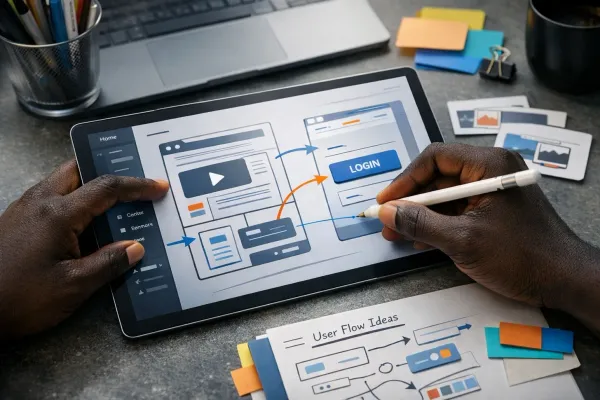
Almost every design tool until now treated the output as a representation: static screens or mockups. Those were plans, not products.
Framer treats the canvas as the product itself.
You can:
• Layout responsive designs that work on real breakpoints
• Add interactions that actually function
• Build stateful UI components
• Use scroll triggers and animations with intention
• Publish live — with a single click
The interface doesn’t look like a prototype that’s pretending to be real. It is real.
This flips the traditional workflow:
Old:
Idea → Mockup → Handoff → Build
New:
Idea → Build → Test → Ship
Cleaner. Faster. More satisfying.
⸻
Why It Matters to Designers
If design is about solving problems for people, then tools should help you see those solutions in action— not just imagine them.
Framer gives designers:
• Tangible outputs: You’re not proving a concept — you’re producing it.
• Iterative speed: Whatever you build can be tested, refined, and shared instantly.
• Ownership: No waiting on translation from one tool to another or from one person to another.
Instead of designing how something should look, you’re designing how something should behave.
⸻
Interaction Is Becoming a First-Class Citizen
Most design tools are fine for visuals — but fall short when it comes to motion, interaction, or logic.
Framer doesn’t treat those as “add-ons.”
They are built into the system.
Motion, trigger states, transitions — these aren’t just decoration. They are communication. They tell users things without words. They show hierarchy, intent, feedback, and flow.
When a tool helps you design behavior, you stop thinking in screens and start thinking in experiences.
⸻
Framer as a Creative Bridge
Where traditional tools created a phase, Framer creates a continuum.
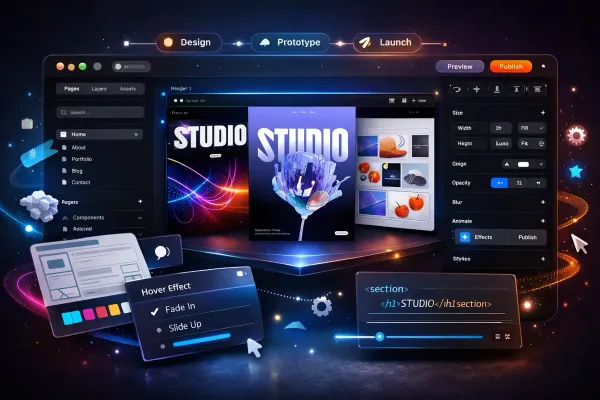
Design → Prototype → Live Site
No artificial walls. No translation layer. No assumption that design stops where code begins.
Framer becomes the place where:
• Designers explore
• Developers extend
• Clients interact
• Users experience
One shared ecosystem, not isolated workstations.
⸻
The Practical Wins
It’s not just theory. Practically, this means:
• Faster iteration cycles
• Higher fidelity demos early in the process
• Better alignment between stakeholders
• Real world usability testing before launch
• Less rework after developer handoffs
So what looked like “just another no-code tool” turns into something more profound: a shared creative environment.
⸻
Why This Is Bigger Than Tools
Design tools come and go. Platforms rise and fall. But shifts in creative workflow last.
Framer is not important because it does what others do.
It’s important because it redefines the relationship between design and product.
It turns thinking into doing.
It turns static ideas into active experiences.
It lets design be production — not just proposition.
⸻
Final Thought
Design isn’t finished until it works.
Development isn’t necessary until it performs.
What Framer delivers is the intersection — a place where both design and performance become visible at once.
That’s not just convenience.
That’s a new creative standard.